
Not long ago, Customer Data Platforms emerged with a bold promise: solve identity.
At the time, it felt like the missing piece.
Customer data was scattered across tools, channels, and devices. The same person would appear multiple times, under different IDs, with no reliable way to connect the dots.
Marketing teams struggled with personalization.
Analytics teams worked with incomplete datasets.
And every decision was, in some way, built on fragmentation.
CDPs stepped in and said: "We'll unify your customer data." And to their credit, they did.
But in solving one problem, they quietly introduced another, one that's becoming harder to ignore.
The trade-off most teams don’t see at first
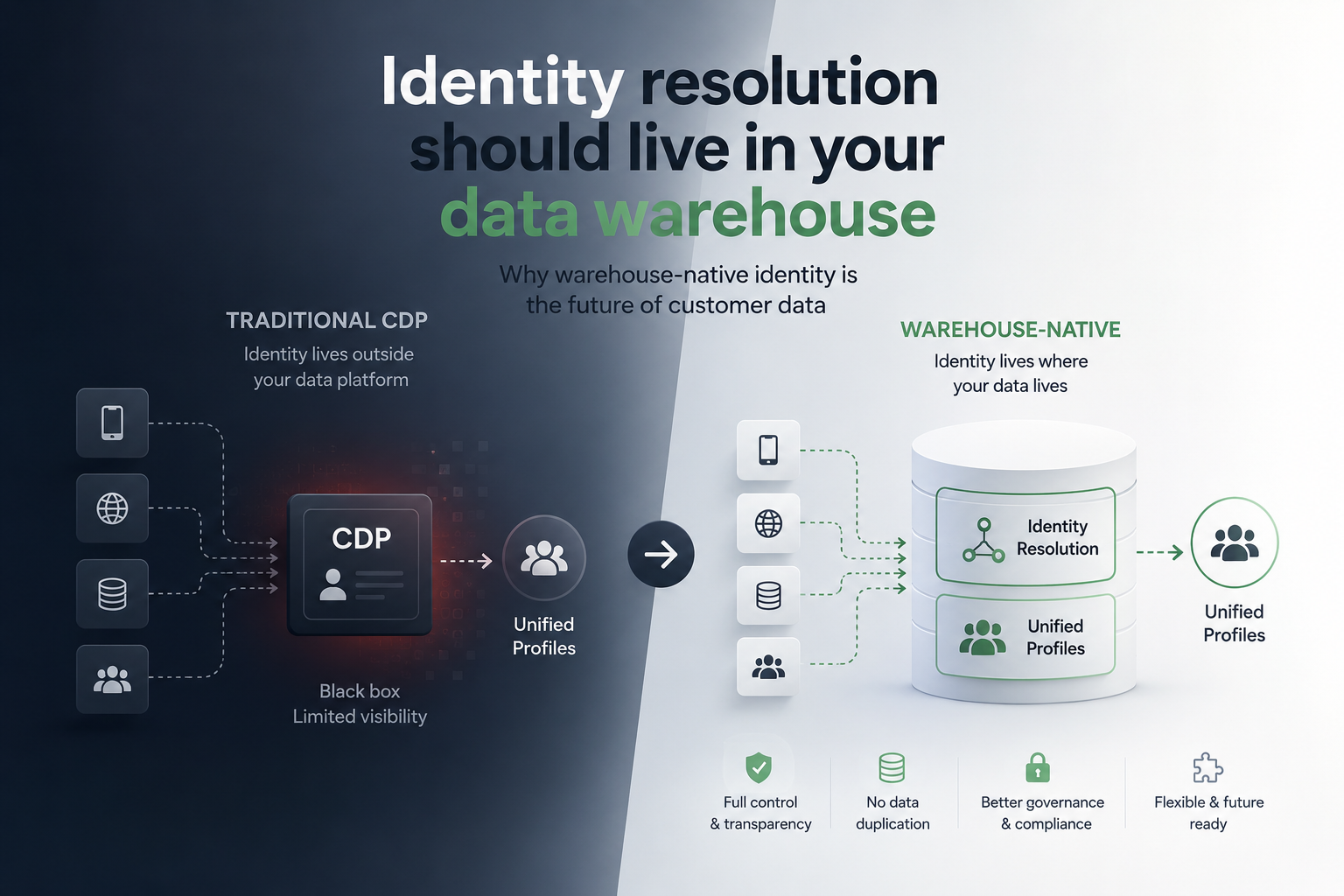
Most CDPs approach identity resolution by building it inside their own environment.
On the surface, it makes perfect sense.
You send data to the CDP, it processes it, resolves identities, and gives you unified profiles.
Simple. Clean. Centralized.
But that simplicity comes with a trade-off: to make it work, data is ingested from multiple sources and moved into the CDP environment.
There, it’s transformed, stored, and made available for activation.
And at that point, something subtle happens. Your identity logic, one of the most critical parts of your data strategy, no longer lives within your data platform.
It lives somewhere else.
When identity becomes a black box
At first, this isn’t a problem. The CDP works. Profiles are built. Campaigns run.
But over time, questions start to emerge:
"How exactly was this profile constructed?"
"Why were these two users merged?"
"Can we change the matching logic?"
"Can we reuse this identity model elsewhere?"
And the answers are not always easy.
Because identity, in this model, is no longer fully transparent.
It's managed inside a system that sits alongside your data platform, not within it.
So even if your company has invested heavily in a modern data stack,
a critical part of your data logic is effectively externalized.
A new kind of silo
This leads to an unexpected outcome.
CDPs were meant to eliminate silos, but in many cases, they've created a new one, more advanced, but still a silo.
You now have:
- a data platform where raw and modeled data lives
- a CDP where identities are resolved
- and a growing separation between the two
Every time you need to investigate, adjust, or extend identity logic,
you have to step outside your core data environment.
And that creates friction, both technical and organizational.
Rethinking where identity should live
Now consider a different approach.
What if identity resolution didn’t happen in a separate system?
What if it lived directly inside your data warehouse?
No data movement to external environments.
No duplication of logic.
No loss of visibility.
In a warehouse-native model, identity resolution runs where your data already resides.
Unified profiles are built there.
Transformations are transparent, queryable, and fully under your control.
Your data team can inspect the logic, evolve it, and integrate it with the rest of your models just like any other part of your data stack.
Identity stops being a product feature.
It becomes part of your data foundation.
Why this shift matters
This isn't just a technical preference. It changes how teams work with data.
When identity lives in your warehouse, you don't have to reconcile multiple systems or wonder where the "real" version of a profile exists.
You maintain control.
You reduce unnecessary complexity.
You enforce governance where it already exists.
And perhaps most importantly, you gain flexibility.
Because identity is no longer constrained by the boundaries of a tool.
It evolves with your data, your models, and your business needs.
Identity is a data problem
One of the biggest misconceptions in the CDP space is treating identity resolution as a feature.
Something a tool provides.
Something you "turn on."
But identity is not a feature.
It's a data modeling problem.
A data infrastructure problem.
A data ownership problem.
And those problems don't belong in an external system.
They belong where your data lives.
A different vision for CDPs
This doesn't mean CDPs are obsolete.
It means they need to evolve.
The future of CDPs is not another platform that takes control of your data.
It's a layer that works with your existing infrastructure.
A layer that connects sources, resolves identities, and builds unified profiles -
without ever becoming the system of record.
And the final question is no longer: "Do you have a CDP?"
But something much more fundamental:
"Where does your identity actually live?"
Because wherever that is, that’s where your control, and your long-term advantage, truly resides.